Showing posts with label Flash. Show all posts

Sunday, February 17, 2013

Pre-Crisis Primer: This is Why the Crisis Needed to Happen

Flash 347-350
“Trial of the Flash Part 6”

Not really a jury of his peers. Moustache man can impale the Flash.
The Trial is over! Behold the verdict for the Scarlet Speedster. Spoiler, he's guilty! How can he be guilty of the Reverse Flash isn't dead?! Prepare your head for some spinning.

Sorry for the overuse of exclamation points there but this final chapter to 'The Trial of the Flash' completely loses its shit. Any semblance of realism in the story disappears (not that here was much to begin with, but when the conceit is a superhero finally being put on trial for taking the law into their own hands, that's an interesting attempt at realism) and transference of souls, time-travel and resurrection are the plot points we're bombarded with.

Despite the best efforts of Flash's formerly-antagonist-lawyer-now-turned-best-pal, the jury returns a verdict on Flash's complicity in the murder of the Reverse-Flash: guilty. Flash, being the hero that he is agrees to go to jail, even though there's nothing stopping him from just flat-out running off and finding a new life elsewhere that doesn't include running fast. No, society has spoken and Flash will be a hero until the end and accept the punishment meted out. One disappointing aspect of the end of this story has been the lack of a lot of involvement from Flash's friends in the Justice League. The JLA shows up once, to admonish the Flash, basically and Green Lantern (the Hal version), Barry's best friend, shows up to offer some salient advice, but other than that they don't do much. You'd think any of them would deign it worth their time to show up at the trial, maybe play as a character witness, or at least visit the poor schlep in jail, at the very least give him hell for how he treated his wife-to-be. Sure, he saved her life, but left her to languish in a mental hospital. Nope, we don't get to see them at all. Perfect point for some inter-title continuity, but instead Flash is in a world all his own.

Screw you guys, I'm outta here.
Also, just an aside because I've spent so much time on this part of the story: after Fiona Webb's relapse in court during the previous part of this story she does not show up at all in this story again nor in the entirety of Post-Crisis continuity. That's it, Fiona's story ends with a mental breakdown. She deserves a lot more than the Flash.

I'm also going to throw out that Flash deserves a better ending than what's presented here. To skip ahead a bit: Flash 350, the final chapter in this story is always the final issue of the series. Considering that 'The Trial of the Flash' has been going on for almost 2 years right now, it's safe to assume this story was not planned to end the series, it's just the way things shook out. The way events quickly devolve from any kind of rational method of story-telling into the crazy shit I'll type out in the next paragraph has to do with the writer struggling to give the entirety of the Flash's superhero career some kind of closure.

Let's do this: Flash's guilty verdict is the result of jury manipulation, obviously. Or, given the events that lead up to it, not so obviously. While the jury had come to a not-guilty verdict on their own, there is one verdict, a portly bald accountant by the name of Newbury who has access to advanced technology and claims that, if the jury deadlocked or came back with a guilty verdict, would ensure that a not-guilty verdict would be missed. So how did this mysterious man fail so miserably? That would be the mysteriously returned Reverse Flash who takes the identity of one of the jurors and is able to use similarly advanced technology to what Newbury possesses and force a guilty verdict. Where does this deluge of jury-verdict-changing technology come from?

A whole lot of jury-tampering brought us to this moment.
What the fuck is going on? Reverse Flash is still dead, a newly-introduced villain to this story by the name of Abra Cadabra is to blame and has been donning the identity of the deceased banana-colored villain. Abra hails from the 64th century where' he's a failed magician and entertainer who eventually travels back to the 20th century to find audience, passing off advanced technology as real magic. At some point he becomes a criminal and is punched by the Flash several times which leads to this plot to ensure a guilty verdict for the Flash. But who is Newbury? Newbury is also from the future, attempting to thwart Abra Cadabra by making sure the not-guilty verdict recorded by history in the 64th century comes to pass. Flash should be exonerated! Newbury is a resident of Central City 20th century possessed by the should of Barry Allen's murdered first wife Iris West. I know, I know, get this: Iris was never killed in our time: at the moment of her death West's relatives from the future snatched her soul to the future and placed it in a new body. Later, when Barry needs her help during the trial, West's soul is sent back to the past to inhabit the body of Newbury. With this revelation, Flash's body is whisked to the 64th century where he's reunited with his first wife and lives happily every after. To the people of the 20th century, Flash was found not-guilty and simply disappeared.

With these revelations, he should have stayed in jail.
  Yeah bu-whu?

That's how it ends? With this future soul-stealing mumbo-jumbo and two main characters introduced into the end of a 25-part series? What a disappointing ending. Screw it, what a crap ending. A ton of new elements are introduced at the end that take the focus away from the trial, abandon established characters like Fiona Webb or Flash's lawyer and shoe-horns in a convoluted attempt at a happy ending tied in a bow. I don't buy it and this is the kind of crap that leads to superhero comics being maligned as mediums for decent story-telling. Don't worry, Crisis is coming to clean this up and hopefully wipe it away.

At least the public knows he's not guilty even though getting there was  a hell of a trip.

Monday, January 21, 2013

Pre-Crisis Primer: Say No to Superhero Fascists

Flash 341 – 346
'Trial of The Flash Part 5'

He's going for an insanity plea.
After months of litigation and an odd, kinky, S&M assassination attempt by Flash's greatest enemies, it's finally time for the titular trial to get underway. Courtroom drama ahoy!

We're well aware at this point that Flash is on trial for killing the Reverse Flash, but what's the charge? Originally charged with manslaughter, everyone giving the scarlet speedster the benefit of the doubt that he didn't mean to kill the villain, the charge is replaced at the start of the trial with second degree murder meaning that Flash, while not planning to murder someone that particular day, did make a thoughtful situation to kill a son-of-a-bitch. Which he then succeeded in doing. With his bare hands, the barbarian. The doubt is no longer in Flash's benefit.

The prosecutor seems to have a personal grudge against the Flash, but we later see that this is far from the case: he shakes Flash's hand and admits the hero saved him and his family a few years prior. Far from being just another lawyer-cliche dick, the prosecutor makes a good point for not only pursuing the trial but also jumping the charge to the more sever choice being that superheroes are not society's appointed protectors but are instead self-appointed. 

Let Flash off the hook once, and it's murder-city.
In the beginning people were happy to overlook the sudden appearance gaudily-costumed people with powers who seem to follow and enforce the laws of society. Superheroes are not an agent of change but instead an agent of the status-quo. They prevent change in most instances; reactive and not proactive. Superman does a lot of cool things but he doesn't march on for change and mostly keeps out of international incidents that would break laws. The Flash killing Reverse Flash is supposedly the first time in the DCU that a superhero, at least in terms of this trial, is accused to have taken it upon himself to murder another individual, bad or not. Because the Reverse Flash was supposed to be innocent until proven guilty; that's a tenet of most international judicial systems. As a society, all we have to tell us Reverse Flash was guilty of anything is the Flash's interpretation of events. That's not good enough and it really shouldn't be. It's a strength of the story that the reader is able to understand why someone would want to prosecute a lovable red hero and also be able to agree with the character. If Flash is allowed to work completely outside the law rather than just on that odd border that vigilantes can occupy, then what's to stop this behavior becoming commonplace? That's a superhero tyranny and that's a big 'hell-no' for this intrepid crusading prosecutor. Unsung hero of 'The Trial of The Flash' right here. 

The perfect secret identity: ugly.
This trial is also, of course, not without its quirkiness. If it were to just be a normal trial, where would the drama be? No, Big Sir crashes the place again manipulated by the Flash's colorful bank-robbing bad guys into being a man-baby assassin. Not a friend worth having Flash, especially when his huge orange (?) mace ruins your damn face. In true comic-book fashion Flash takes the opportunity to run (across the Atlantic, go super-speed), mangled face and all, to the hidden African nation of Gorilla City. This is where Gorilla Grodd comes from: a whole city full of super-evolved, super-strong, telepathic, nude-as-hell gorillas. While cool in a science-fiction/pulp mash-up it's still slightly racist (go comics?). The gorilla-scientists do give Flash a new face out of the deal though. No more Barry Allen!

In the more soap-opera aspects of the trial, Fiona Webb, present at the trial as a form of therapy has a mental relapse when talk of the Flash's trial turns to Barry Allen (and still, Barry does nothing to help the woman he wanted to marry) and, I'll skip ahead a bit here, she's not seen again during the entirity of the story. Fiona's story ends with her being carted to the hospital after suffering a sever mental break from reality. I've mentioned numerous times how much of a dick the Flash is for not doing much to help Fiona so I won't bemoan the point here. On a lighter note, Flash's lawyer thinks he's a dick too, but she's still agreed to defend him. In dramatic fashion we find out she's harbored this anger towards the Flash because she believed him responsible for her father's death. She was wrong, it was a gangster by the name of Goldface (he who has gold skin, Green Lantern would love this guy). With this knowledge she can now feel safe being friends with the murder-happy speedster.

Goddamn Judas.
But, the most damning drama is of course the testimony of one retired superhero: Kid Flash! Even worse, his testimony amounts to Flash had many options in disarming The Reverse Flash that didn't have to satisfy his raging murder boner. Things aren't looking to good for The Flash at the close of this chapter.

But here's the good news! The Reverse Flash isn't dead! He shows up and begins kidnapping Flash's enemies for some nefarious reason. No, wait, that's horrible news. I'm pretty sure The Flash is screwed now.

Good thing/bad thing.


Monday, December 10, 2012

Pre-Crisis Primer: Flash Takes On Six Guys

The Flash 337-340
“Trial of The Flash Part 4”

Gang-bang gone wrong.
While the lawyers convene at court and jury selection begins on the murder trial of the Flash, the scarlet-clad superhero concerns himself with other things, namely an attack by an army of villains. The thing to remember with these villains is that they are far from the silliest Flash has faced. No, these are the serious guys.

The Pied Piper, who aided in the destruction of the FlashMuseum, as well as trying to kill the mayor and frame Flash wants to take advantage of Flash's murder-trial situation just to cause the hero grief. This is what villains do, so it's hard to really fault him this. Flash finds fault with it though and after a ludicrous sequence in which Piper reveals that he can use his pipes to open a rift to a hidden dimension and summon what are, for lack of a better term, sound demons, pummels Piper into brain damage. Really, he's left a gibbering, grinning loon after all is said and done. Going along with the old adage of 'honor among thieves,' some of Piper's friends in the rogues business don't take too kindly to this turn of events.

Piper's big plan. Turn Flash into a fucking yo-yo.
Flash is an expert about sending people to the mental house, so while he's slightly remorseful, about as remorseful as he is regarding his wife-to-be's stay in the hospital, Piper apparently had it coming. At least Piper has friends who give a damn about what happens to him in the guise of Captain Cold, bank-robber extraordinaire who wears a parka all year-round and wields a cold-gun; Trickster, maniac anarchist who uses weapons disguised as practical jokes; Captain Boomerang, Australian mercenary who uses, survey says, trick boomerangs; Weather Wizard, would-be criminal who can control the weather; and finally, Mirror Master, an assassin who has a gaggle of trick mirrors at his disposal. Together, with the Pied Piper, as well as The Reverse-Flash, when he was alive, these villains comprise The Rogues, Central City's greatest assemblage of crime.

I came up with that phrasing myself and it's not bad.

They're really trying to hide Big Sir. With a ground-level rain cloud.
Put these masterminds in a room and what comes out is a fairly round-about, fairly stupid plan to finally kill The Flash. Thinking The Flash meant to kill both the Reverse-Flash as well as incapacitate Piper, The Rogues begin fearing for their own lives and agree to dress up a super-strong man with the mind of a child as a villain and set him loose on The Flash. They also have the gusto to engage The Monitor to provide the dangerous armor and armament that will make the deranged man-child Big Sir an unstoppable killing machine. Monitor's spent enough time arming and providing super-villains with work and weaponry all under the guise of averting or perpetrating some forthcoming disaster (Crisis, duh) so he goes along with their silly plan. 

Just remember they had to strip him to dress him.
Of course this doesn't work, not only does The Flash not die, but he ends up making friends with his would-be assassin, the moronically-named Big Sir. The Rogues are able to make their escape and Flash is able to make it to court on time...for his trial to begin.

My praise from Part 1 of this story seems to have been premature. 'The Trial of The Flash' drags in this middle section, with Flash's supposedly impressive rogues gallery proving themselves to be just as stupid as they look. There's none of the real kookiness or Silver-Age charm here, just a bloated story that feels like its buying time, stretching itself thin just to make it to the next milestone issue (350) and the moment to finally put this story out of its misery. With the titular trial finally happening, I hope things look up, if not for The Flash, then for the reader.

These are the crazy things I love about The Flash. Batting away an RPG with a protestor's sign.

Tuesday, October 30, 2012

Pre-Crisis Primer: No Love for The Flash

The Flash 334-336
“Trial of The Flash Part 3”

Even flash's lawyer thinks he's slime. Plus he's trying to pimp.
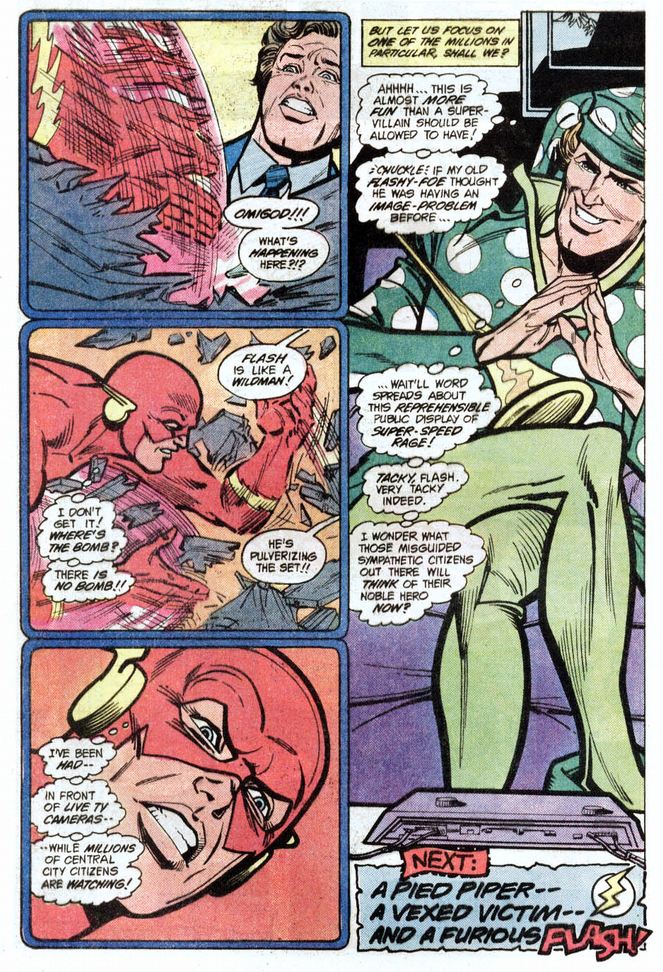
The villain behind the destruction of The Flash museum last issue is revealed! It's anticlimactic: the Pied Piper. Piper is a master of aural technology who dresses in a stupid costume and hat to use special weaponized whistles and pipes. With these instruments of doom, Piper can either hypnotize others into doing his bidding or he can outright kill a man. Angered at Central City's mayor's continued support of The Flash even in the face of the impending murder trial. Makes Pied Piper angry!

While Piper takes control of the mayor and sends him on a binge of Flash-trashing tactics, Barry has problems of his own: namely his lawyer hates him. All this before we even get to the start of the trial. It's not divulged why Flash's lawyer hates him so much, in fact she only took the case because her partner urged her too, thinking her the best person to get an acquittal for the Scarlet Speedster. Whenever the question is brought up regarding why Flash's lawyer, Cecile Horton, might have distaste towards him, she becomes cryptic and clasps a medallion around her neck between her fingers. It looks to me like she's just daring the Flash to rip the necklace from her and figure out the damn reason already. The mystery is show-horned in and poorly played so far. Instead of being intriguing, it's mostly boring and sometimes annoying. It's not much a of a mystery: it'd be solved if Flash and Cecile could just act like adults and discuss their differences instead of all the maudlin hand-wringing.

Although, all will be forgiven if Cecile reveals herself to be the long-lost sister, friend, whatever of Fiona Webb. That would make sense to me.

Busted by the cops.

Why the sub-plot weakly percolates in the background, the main thrust of these issues is Pied Piper taking control of the mayor and using him to tarnish the Flash's name. Denying Flash privileges of the city, speaking out against him in public, and also sending him on wild goose chases like the one that ends with Flash man-handling a TV news anchor live on-air. Instead of explaining himself, Flash just takes off. So of course public opinion takes a shit on the immature hero.

I'm not really sure what's up with this series, I was very excited about the premise when the story began, but now it's just treading water and stretching sub-plots that could be wrapped up in an issue or less to almost a year in length. This series as been disappointing, but I'm holding out final judgment for the start of the trial. With luck that will bring back some of the story-telling that was present when the story started.

Pied Piper is very, very secure.